
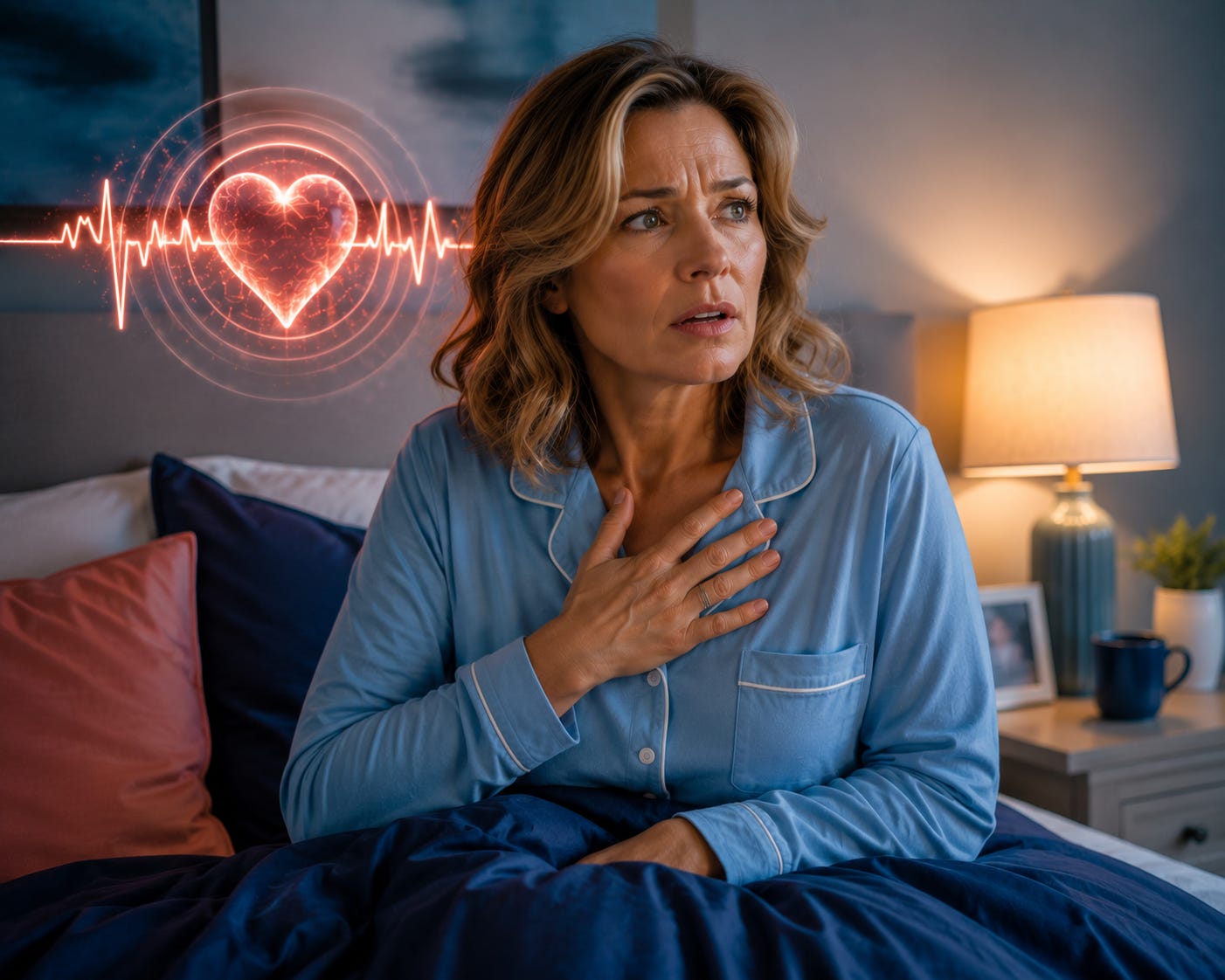
Have you ever been lying in bed, almost asleep, when suddenly your heart decides it’s time to audition for a drum solo?
Thump.
Thump.
Flutter.
Pause.
THUMP.
If you’ve experienced it, you know exactly what I’m talking about.
And if you’re anything like the women I work with, your first thought probably wasn’t, “Oh, this must be perimenopause.”
It was more like...
“Should I call 911?”
I wish someone talked about this symptom more often because heart palpitations are surprisingly common during perimenopause. They’re also one of the symptoms that sends women down a Google rabbit hole at two o’clock in the morning.
I know because I’ve been having this conversation for years.
Women tell me the same story over and over.
“I honestly thought something was wrong with my heart.”
The good news?
In many cases, your heart isn’t the problem.
Your hormones are simply changing the conversation.
Estrogen Myth
One of the biggest myths about estrogen is that it’s only involved in reproduction.
If only it were that simple.
Estrogen has a hand in almost everything.
Your brain.
Your bones.
Your muscles.
Your metabolism.
Your blood vessels.
Your sleep.
Even the way your nervous system talks to your heart.
During perimenopause, estrogen doesn’t quietly fade into retirement. It behaves more like an unpredictable coworker who keeps changing the schedule without telling anyone.
One day it’s here.
The next day it’s not.
Your body spends years trying to keep up.
Estrogen & Your Nervous System
Here’s where things get interesting.
Your autonomic nervous system controls all the things you don’t consciously think about, your heartbeat, breathing, blood pressure, digestion, and more.
Estrogen helps keep that system steady.
When estrogen begins fluctuating, your nervous system can become more reactive.
Suddenly your heart seems to have a personality.
It races.
It flutters.
It pounds.
Sometimes it feels like it skipped a beat altogether.
It’s unsettling.
It’s uncomfortable.
And yes, it can be downright scary.
But here’s something I remind my clients all the time.
Your body isn’t betraying you. It’s communicating with you.
Heart palpitations are often another clue that your hormones are shifting.
When to Seek Medical Attention
Now, before we go any further, let’s talk about the important part.
Not every palpitation should automatically be blamed on menopause.
If you ever experience heart palpitations along with chest pain, shortness of breath, fainting, severe dizziness, or unusual weakness, don’t try to diagnose yourself.
Get medical attention immediately.
And if these episodes are becoming more frequent, lasting longer, or simply feel different than what you’ve experienced before, it’s time to check in with your healthcare provider.
I always tell women that understanding menopause doesn’t replace good medical care.
It makes you a better partner in it.
Once you’ve ruled out a heart condition, there are several simple things that often help.
Hydration matters more than most people realize.
Stable blood sugar matters too. A day fueled by coffee and crackers isn’t doing your nervous system any favors.
I’ve also seen many women notice fewer episodes after reducing caffeine or alcohol—even if those things never bothered them before.
Perimenopause has a funny way of changing the rules.
Movement helps.
Sleep helps.
Managing stress helps.
And something as simple as slowing your breathing can calm an episode surprisingly quickly.
Try breathing in for four counts and out for six.
Longer exhalations tell your nervous system it’s safe to settle down.
Sometimes that’s exactly what it needs.
Symptoms Make Sense When You Understand the Biology
One of the reasons I love teaching about menopause is because symptoms finally begin to make sense.
Heart palpitations.
Brain fog.
Poor sleep.
Weight gain.
Joint aches.
Mood changes.
Anxiety.
Women often think they’re dealing with ten unrelated problems.
More often than not, they’re looking at one beautifully connected hormonal picture.
That’s why I say I’m in the business of connecting the dots.
Because once you understand what’s happening, everything changes.
You stop blaming yourself.
You stop wondering whether you’re imagining things.
You stop buying every supplement that promises to “balance your hormones.”
Instead, you begin making informed decisions based on science, and on what your own body has been trying to tell you all along.
And that kind of clarity is incredibly freeing.
What to do Now
So if your heart has been putting on an unexpected performance lately, take a deep breath.
Listen to your body.
Get checked if something doesn’t feel right.
Then remember this:
Your body isn’t working against you.
It’s asking you to pay attention.
Sometimes the most unsettling symptoms turn out to be some of the most important clues.
And once you know how to read those clues, the menopause transition becomes a whole lot less mysterious.
That’s exactly why I created my Hormone Clarity Tool, to help women stop guessing and start understanding what’s really happening beneath the surface.
Because clarity doesn’t just reduce fear.
It gives you your confidence back.