
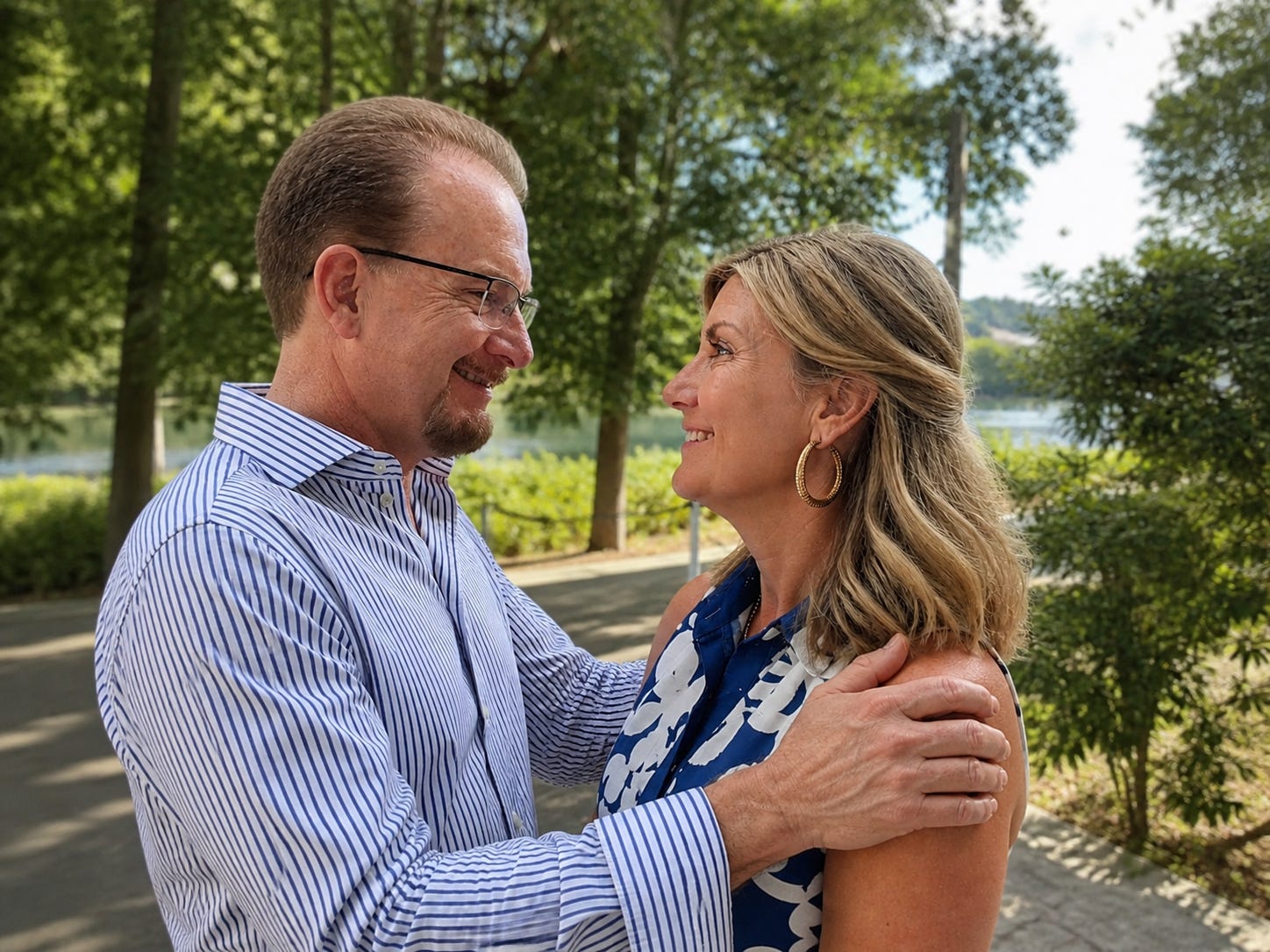
He didn’t say it with alarm. He didn’t say it with frustration. He said it the way you say something to someone you love when you have been waiting patiently for the right moment.
My husband put his hands gently on my shoulders, looked at me, and said: “Denise, something is going on with you, and we need to figure out what it is.”
I wanted to brush it off. I had been telling myself for months that I was fine, just a little stressed, a little tired, running on fumes from traveling and pouring so much into my clients. I was a health & life coach. I knew about wellness. I was managing.
Except I wasn’t, really. And somewhere in the quiet underneath all that managing, I already knew it.
That moment with his hands on my shoulders, the look on his face was the thing that finally made me stop and actually ask the question I had been avoiding: what is actually going on here?
I didn’t expect the answer to be so surprising. Or so fascinating. Or so completely logical once I understood it.
What followed was months of reading, researching, and connecting dots I hadn’t known needed connecting. And what I found changed the way I understand my body completely.
That’s what this Substack is about. Not prescriptions or programs — just the genuinely interesting science of what happens to a woman’s body in midlife, told in a way that actually makes sense. Because once you understand it, so much clicks into place.
Here’s the thing nobody tells you
We talk about menopause like it’s one event. Like there’s a before and an after, and somewhere in the middle you have a hot flash and then it’s done.
But that is not what actually happens. What actually happens is more interesting, and more complicated than that.
Starting in your late 30s or early 40s, your hormones begin a long, uneven, sometimes chaotic transition. Estrogen and progesterone, which most of us think of purely as reproductive hormones, start fluctuating in ways they never have before. Some months they surge. Some months they drop. The rhythm you have had your entire adult life starts to shift.
And here is the part that I absoluetly did not know: estrogen and progesterone were never just reproductive hormones. They were doing an enormous amount of work throughout your entire body, quietly, in the background, for decades.
They were anti-inflammatory agents. They helped regulate your metabolism, your sleep, your mood, your stress response, and your immune system. They were, in a very real sense, the reason your body felt like it was working with you.
So when they start to change , and they change gradually, then suddenly, then gradually again , your body has to recalibrate an enormous number of systems all at once.
The fatigue, the weight shifts, the 3am wake-ups, the mood changes, the joint aches, the feeling that you are somehow not quite yourself; that is not aging. That is recalibration.
And there is a significant difference between those two things. One you just endure. The other you can actually work with.
The part I find genuinely fascinating
Once I started understanding the hormonal picture, I became a little obsessed with the connections. Because they are everywhere, once you start looking.
Did you know that estrogen directly influences how your immune cells behave? Or that progesterone is one of your body’s natural calming agents, which is why its decline often shows up as anxiety or disrupted sleep before any other symptoms? Or that the gut microbiome shifts during perimenopause in ways that affect everything from how you absorb nutrients to how you process mood-regulating neurotransmitters?
It is all connected. In ways that are, honestly, kind of amazing when you see the whole picture.
Every week I am going to bring you one piece of that picture. Not in a “here is what to eliminate from your diet” way. In a “wait, did you know this?” way. The kind of thing you read and then immediately want to tell someone about.
Some weeks we will go deep on hormones. Some weeks it will be sleep, or inflammation, or the gut-brain connection, or why stress hits differently in midlife than it did in your 30s. Always with the real science behind it, made interesting, not intimidating.
My goal is simple: I want you to understand your own body so well that nothing it does surprises you anymore.
So — welcome
If you have been feeling like something changed and you couldn’t quite name it, you are in the right place.
If you are the kind of person who wants to understand the why, not just be handed a list of things to do, you are going to love what we get into here.
And if you are just genuinely curious about what is happening in the fascinating, complicated, wildly underresearched body of a midlife woman, pull up a chair. It gets interesting.
My husband was right that day. Something was going on. And figuring out what it was turned out to be one of the best things I ever did.
I’m so glad you’re here for it.
Next week: It’s Not a Slow Metabolism — It’s a Metabolic Flip.
We get into the specific shift that happens in how your body stores and burns fat in midlife, and why everything you used to do stopped working. It’s one of those pieces where things suddenly make a lot of sense.
If this resonated, I’d love to hear from you. Reply and tell me — what made you find your way here? I read every response.
And if you know someone who has been quietly wondering what is going on with her body, send this her way. Sometimes the right words at the right time make all the difference.
PS: That is really a picture of me and my husband, Mark!