

They look like separate problems. They are not. Here is the single story running underneath all of them.
Let me guess. At some point in the last year or two, you have been dealing with some version of this list:
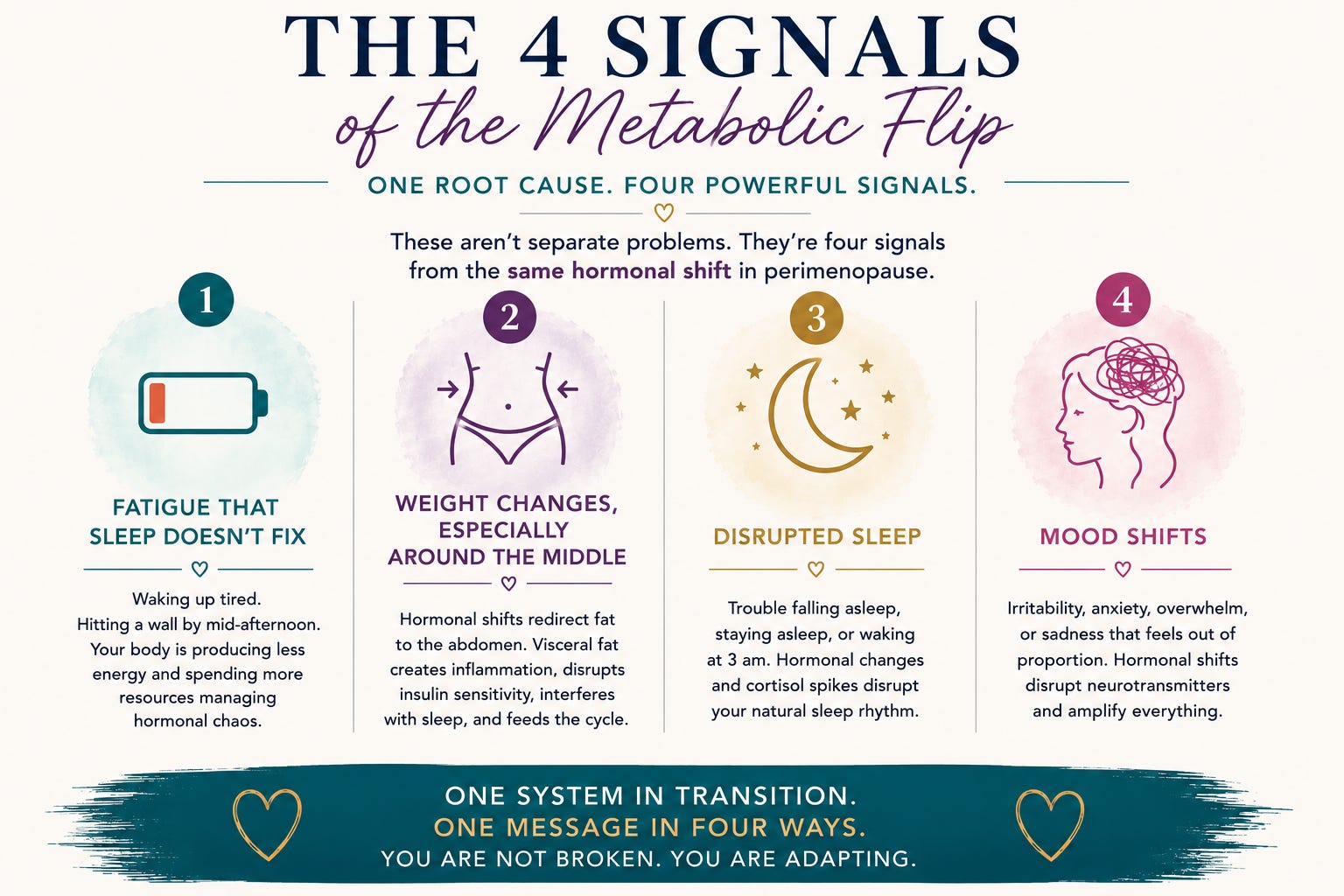
Fatigue that sleep doesn’t fix
Weight changes, especially around the middle
Disrupted sleep — trouble falling asleep, staying asleep, or waking at 3 am
Mood shifts that feel out of proportion or hard to predict
Maybe all four. Maybe two or three. Maybe they came on gradually, or maybe they seemed to arrive all at once. Either way, you have probably been treating them as separate problems: a sleep issue here, a stress issue there, a metabolism issue somewhere in the middle.
Here is what I want you to know today: these are not four problems. They are four signals from the same source. And the moment you see them that way, everything about how you respond to them changes.
Your body is not randomly falling apart in four different directions. It is sending you one message, four different ways. The question is, are you reading the whole message?
Let’s move through them quickly, and then connect the dots.
Signal 1: Fatigue That Sleep Doesn’t Fix
This is not ordinary tiredness. This is the kind of fatigue where you wake up after seven or eight hours and still feel like you haven’t slept. Where you hit a wall at 2 pm that feels less like sleepiness and more like someone quietly pulled your plug.
What’s driving it: as estrogen and progesterone fluctuate, your cells’ ability to produce and use energy efficiently changes. Mitochondria — the energy factories inside your cells — are directly influenced by estrogen. When estrogen drops, cellular energy production can become less efficient. Add disrupted sleep and elevated cortisol into the mix, and your body is spending enormous resources just managing the hormonal chaos — leaving less available for everything else.
This fatigue is not laziness. It is not depression. It is your body redirecting its energy budget during the Flip.
Signal 2: Weight Changes, Especially Around the Middle
We covered this in depth last week, the hormonal shift that redirects fat storage from the hips and thighs to the abdomen as estrogen declines and cortisol becomes more dominant. But here is what is worth adding in the context of the four signals: the weight change and the fatigue feed each other.
Visceral fat, the kind that accumulates around the abdomen during the Flip, is metabolically active in ways that subcutaneous fat is not. It produces its own inflammatory signals. It disrupts insulin sensitivity further. It can interfere with sleep quality. And it is sensitive to cortisol, meaning the more stressed your system is, the more efficiently it accumulates.
The belly is not a separate problem from the fatigue. They are part of the same hormonal conversation.
Signal 3: Disrupted Sleep
Night sweats, restless nights, the infamous 3 am wake-up that leaves you staring at the ceiling with your thoughts running at full speed. Sleep disruption in midlife is so common that it has become almost a punchline, but it is worth understanding exactly why it happens, because it is not random.
Progesterone is one of your body’s natural sedatives. It has a calming, sleep-promoting effect that most of us never consciously notice until it starts to decline. At the same time, estrogen helps regulate body temperature. As it fluctuates, the thermoregulation system becomes less stable, which is why night sweats and temperature-related waking are so common in perimenopause. And cortisol, which should be at its lowest in the early hours of the morning, can spike unpredictably, which is what wakes you at 3 am feeling alert and anxious for no obvious reason.
The 3 am wake-up has a name in research: nocturnal cortisol arousal. It is directly linked to the hormonal shifts of perimenopause and is one of the earliest and most consistent sleep complaints women report, often years before other menopause symptoms appear.
Signal 4: Mood Shifts
Irritability that arrives out of nowhere. Anxiety that doesn’t have a clear source. A shorter fuse. A lower threshold for overwhelm. Moments of sadness that feel disproportionate. Many women in perimenopause are diagnosed with anxiety or depression at this stage, and while those are real and valid experiences, what often goes unexamined is the hormonal engine underneath them.
Estrogen influences three of the brain’s primary mood-regulating neurotransmitters: serotonin, dopamine, and GABA. When estrogen fluctuates unpredictably, so does the availability of these chemicals. Progesterone, as we noted, is naturally calming, so its decline removes a buffer the nervous system has relied on for decades. And poor sleep, which we have just covered, is one of the most powerful mood disruptors there is.
The mood shifts are not a character flaw or a mental health crisis in isolation. They are a neurological response to a hormonal shift, and they are deeply connected to everything else on this list.
Now, the single story underneath all four
Here is what connects them. Every one of these four signals, the fatigue, the weight changes, the disrupted sleep, the mood shifts, traces back to the same root: the hormonal recalibration of the Metabolic Flip.
Declining and fluctuating estrogen and progesterone disrupt cellular energy production, which drives fatigue. The same hormonal shift redirects fat storage and reduces insulin sensitivity, which drives the weight changes. Progesterone loss and cortisol dysregulation disrupt sleep architecture, driving disrupted nights. And the loss of estrogen’s moderating effect on neurotransmitters, compounded by poor sleep and elevated stress hormones, drives the mood shifts.
Pull on any one of these threads, and you find the same thing underneath. This is one system in transition, not four systems breaking down independently.
Why does this matter so much? Because when you treat them as four separate problems, you end up with four separate approaches — a sleep supplement here, a diet overhaul there, a mood management strategy somewhere else, and a lot of frustration when none of them quite stick. When you treat them as one connected story, you address the root rather than the branches. And that is when things actually start to shift.
The Metabolic Flip is not doing four things to you. It is doing one thing, recalibrating your hormonal operating system, and you are feeling it in four different places.
Understanding that is not a small thing. It is actually the most important reframe in this entire series. Because once you see the whole picture, you stop fighting symptoms and start working with the system.
A quick note before next week
We have now covered the what and the why of the Metabolic Flip across three weeks. Starting next week, we will go into the specific systems that drive it, beginning with inflammation, which is the thread that connects more of your midlife symptoms than almost anything else.
If you have been feeling like your body is overreacting to everything physically, emotionally, and immunologically, next week is going to be a very interesting read.
Next week: The Hidden Fire- Inflammation.
Low-grade chronic inflammation is at the root of so many midlife symptoms that get explained away as “just aging.” Next week, we shine a light on what it actually is, why it spikes during the Flip, and why understanding it changes everything about how you take care of yourself in midlife.
Which of the four signals hit closest to home for you? Reply and tell me, I read every single one, and your answers shape where we go deeper.
And if this connected some dots for someone you know, send it her way. The more women who understand this, the better.